


Article: Do Candles Get Rid of Cooking Smells?
Do Candles Get Rid of Cooking Smells?
A vanilla candle and last night's salmon make a smell worse than either one alone.
That's the part nobody tells you. You cook, the kitchen holds onto it, you light the nearest candle, and an hour later the room smells like sweet fish. The candle didn't fail because it was cheap. It failed because sweet fragrance and cooking odor don't cancel each other out. They combine.
So the honest answer to the question: no, a candle does not remove cooking smells. It covers them. The air handles the removal, and a candle can't move air.
That's not a reason to skip the candle. It's a reason to use it for what it actually does, and to open a window while you do.
What actually removes cooking smells
Ventilation. The EPA's guidance on indoor particulate matter is specific about it: run the range hood every time you cook, vent it outdoors if you can, leave it running for 10 to 20 minutes after you're done, and cook on the back burners so more of what comes off the pan gets pulled into the hood. Open a window or a door when it's safe to.
None of that costs anything. All of it works better than any product you can buy.
The candle comes after. Once the air has moved, a candle puts something in the room you want to smell instead of the ghost of dinner.
Why sweet candles make it worse
Cooking odors aren't one smell. Fish releases trimethylamine. Garlic and onion release sulfur compounds. Frying aerosolizes fat, which is why the smell clings to your hair and the curtains and not just the air.
Sugary fragrance sits on top of those compounds without touching them. You end up smelling both at once, and the combination reads as worse than the original because your nose can't sort it. Vanilla, bakery, caramel, and heavy florals are the ones that do this most reliably.
Bright and sharp scents work differently. Citrus and crisp herbs read as clean air to most people, so they compete with the cooking smell instead of layering on top of it. That's the entire reason lemon shows up in kitchen cleaners.
What scent works in a kitchen?
Citrus and green herbs. Lemon, grapefruit, bergamot, rosemary, mint, eucalyptus, sage.
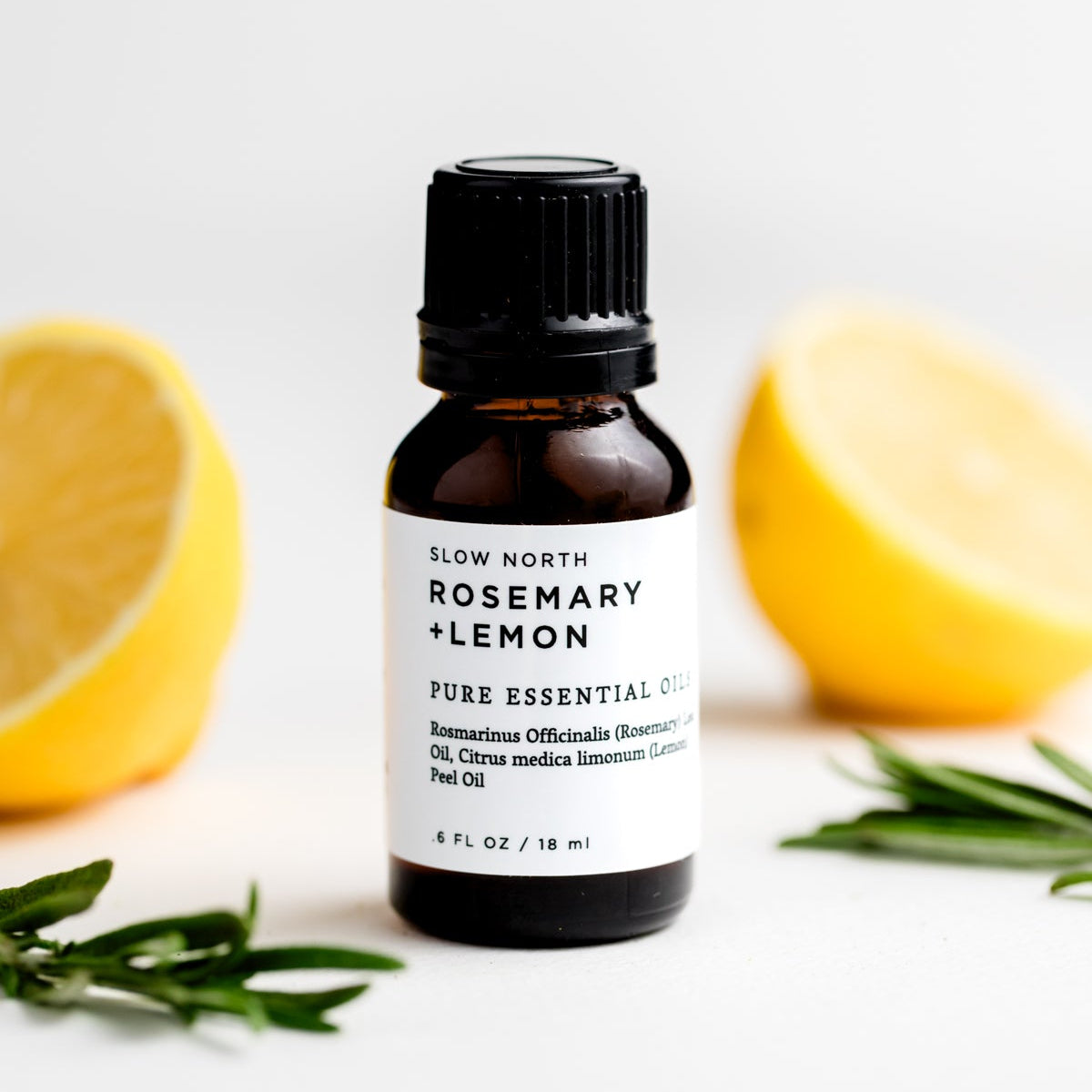
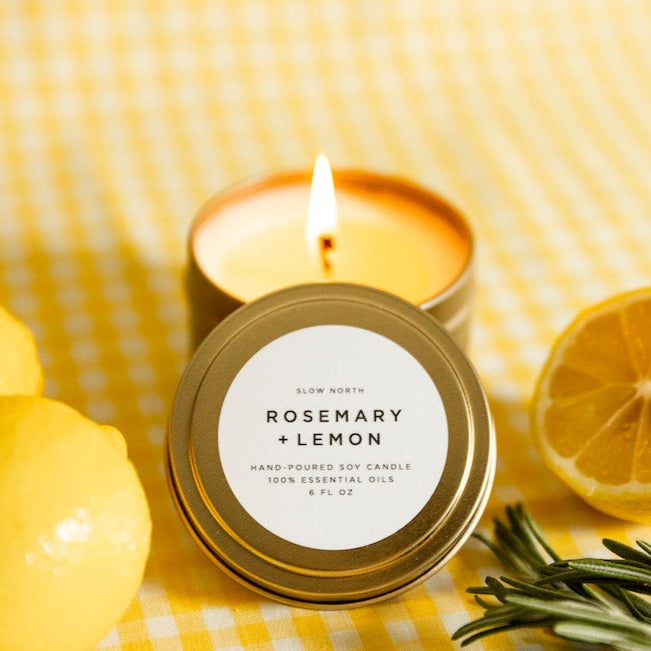
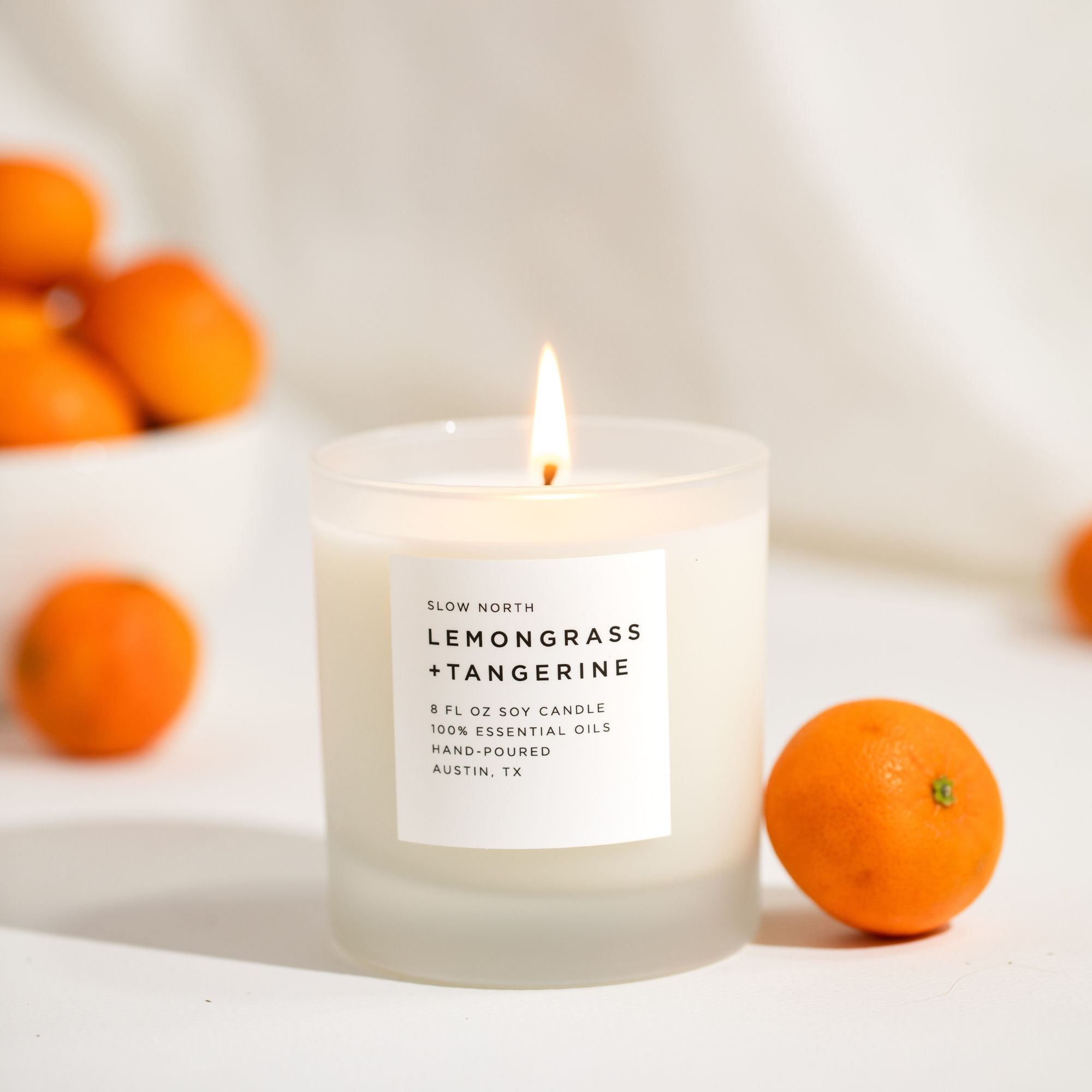
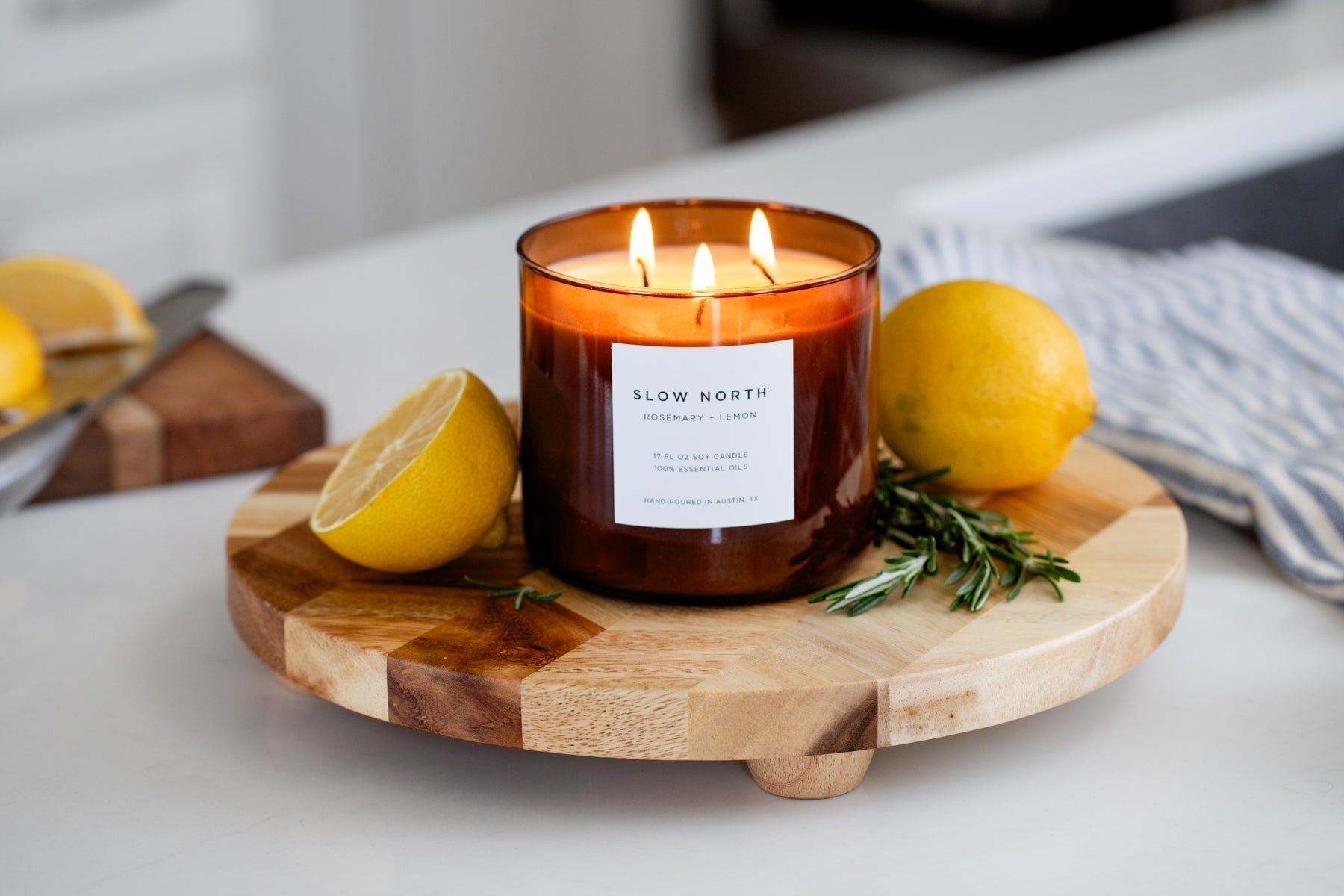
Our Rosemary + Lemon is built on exactly that: lemon essential oil over rosemary. A customer put it better than our product page does. She was going for what she called "kitchen clean," and said it's more lemon-forward than rosemary, which is accurate.
If you want the cozy vanilla candle, burn it in the living room. Kitchens want something that reads as air, not as dessert.

Should you light the candle before or after cooking?
After, and after the hood has been running.
Lighting it before means you're adding fragrance to a room that's about to fill with fat particles and steam, and the two will mix. Cook first, ventilate, then light it. You'll use less candle and get a cleaner result.
Where should you put a candle in a kitchen?
Not on or near the stove. Not under a cabinet, an open shelf, or a range hood. Not within reach of a dish towel, paper towel roll, or curtain, and not where a sleeve will catch it when you reach across the counter.
An island, a far end of the counter, or a shelf across the room all work. Keep it out of the draft from the hood, an open window, or an AC vent, because a flickering flame produces more soot. That matters more than people think, and there's a number on it further down.
How long does it take to clear a room?
Give the hood 10 to 20 minutes after you finish cooking, per the EPA's guidance. A window helps more than the hood alone.
For the candle, let it burn long enough for the melted wax to reach the edge of the jar, usually two to four hours in a full-size candle. A candle that gets blown out early tunnels down the middle, and a tunneled candle throws less scent for the rest of its life.

Do odor-eliminating candles work?
Most of the claims don't hold up. "Enzymes that break down odor molecules" and proprietary neutralizing technology show up constantly in candle marketing, usually with no data behind them and no way for you to check.
A candle is a fuel source with fragrance in it. It smells like something, and it does that well. Any brand telling you their wax destroys odor at the molecular level is asking you to take their word for it, which is the same thing the fragrance industry has been doing for decades.
Fish, garlic, and burnt food
Fish is the hardest and the most worth ventilating for, since trimethylamine is stubborn and clings to fabric. Run the hood while you cook it, not just after.
Garlic and onion fade faster on their own. A citrus candle covers the tail end of it well.
Burnt food is a different problem. The EPA notes that burning food during cooking quickly produces large quantities of indoor particulate. Open windows, run the hood, and let it clear before you light anything. A candle on top of scorch smell is a losing fight.
Does soy or paraffin matter in a kitchen?
Some. A kitchen is already holding cooking residue, so a candle that soots adds to a load that's already there.
The claim you'll see everywhere is that paraffin releases benzene and toluene. The chamber research is messier than that. A 2012 study in Atmospheric Environment found that emission factors for those compounds vary widely between candles, likely tied to the specific paraffinic material used, which means it depends on the candle rather than on the category.
We use soy because it's a renewable crop, it burns slower, and we can trace it. Not because we can promise you a number.
Why don't essential oil candles smell strong enough?
This is the real complaint about clean candles, and it's usually earned. Essential oils are volatile and expensive, so a lot of brands underload them and hope the label does the work.
It's a formulation problem, not a limit of the ingredient. One customer wrote that she had a hard time finding any essential oil candle that put off much smell until she found ours. Another described this one as strong but not overpowering, which is the target.
If you've tried clean candles and found them weak, that's not a reason to go back to synthetic fragrance. It's a reason to be pickier about who you buy from.

What does rosemary and lemon smell like together?
Lemon first, bright and a little tart, with rosemary underneath giving it a green, slightly sharp edge that keeps it from smelling like furniture polish.
One reviewer said it smells like a cleaning product and didn't like it. She's not wrong about the association, and if you want warm and cozy, this isn't it. Another said it counters the musty odors that build up indoors. Both of those are describing the same candle accurately.
Is burning a candle bad for indoor air quality?
Every candle is combustion, so yes, every candle puts particulate into the room. Including ours.
A 2025 study in Scientific Reports measured this in actual homes and found particulate peaked at about 1.5 times the room's baseline at the candle itself after five minutes, with fine particles still elevated three and six meters away later on. Real, and small.
How you burn it matters more than what's in it. Research on candle combustion has found fine particle concentrations running roughly 20 times higher under unstable burning conditions than under steady ones, with particle size jumping from under 100 nanometers in a clean burn to the 400 to 800 nanometer range in soot mode. A trimmed wick and no draft is the single biggest thing you control. It's free, and it beats every other intervention on this page.
A 2021 chamber study in Environment International tested 24 combinations of wax and fragrance and found that in most cases the resulting indoor concentrations came in well below health guidance values, with some exceptions. Worth knowing in both directions.
Here's the part our own industry doesn't publish. Essential oils are not zero. They're terpenes, and terpenes react with ozone that drifts indoors from outside. Limonene, which makes up most of lemon oil, is one of the most reactive of them, and that reaction produces formaldehyde and ultrafine secondary organic aerosols. A separate study analyzing essential oils found that each one tested emitted nine or more potentially hazardous volatile organic compounds, and that fewer than one percent of those appeared on any label or safety data sheet.
We use essential oils because we can name every one of them and you can go look up what it does. That's the difference between our label and a label that says "fragrance," which can legally hide hundreds of undisclosed compounds behind one word. The difference is disclosure. It isn't that our ingredients are inert.
The good news is that the fix for all of it is the same fix. Ventilation clears combustion byproducts, cooking particulate, and terpene reaction products together. Open a window.
Perspective on the numbers
If you're going to worry about the air in your kitchen, worry about the cooking.
A 2024 study in Indoor Air measured peak fine particulate by cooking method. Pan-frying came in at a median of 92.9 micrograms per cubic meter. Stir-frying was 26.7. Deep-frying was 7.7. Boiling was 0.7, and air-frying was 0.6.
Pan-fry a steak with the hood off, and you've done more to your air in ten minutes than a candle does in an evening. That's not an argument for burning candles carelessly. It's the arithmetic of where the risk actually sits, and it points at the same window.
Why do candles give some people headaches?
Usually one of three things: synthetic fragrance compounds, soot from a long or drafty wick, or too much scent in a small closed room. Sensitivity to synthetic fragrance is common enough that a lot of people quit scented candles entirely before they find out that essential oil candles affect them differently.
That deserves its own post.
The short version
Open a window and run the hood. That's what removes the smell, and it costs nothing.
Cook first, ventilate, then light something bright. Keep the wick trimmed and the flame out of the draft. Skip the vanilla until you've left the kitchen.